A balanced perfume comes from the right oils in the right order and proportions. It does not come from mixing the most ingredients. You can create a wearable scent at home with a simple, careful approach.
Start with note structure. Then gather your tools and Fragrance Oils for Perfum. Next, measure your blending ratios. Test each trial on a strip and on your skin. Finish with safe dilution and smart storage habits. Each step builds on the last one. Patience matters more than a large ingredient list. Small, measured batches teach you fast. You will learn how each oil behaves and how the layers support each other.
Key Takeaways
-
Balance your perfume with 50% heart notes, 30% top notes, and 20% base notes.
-
Add base oils first, then heart oils, and top oils last to build a lasting scent.
-
Test each blend on a paper strip first, then on your skin to see how it develops.
-
Dilute your perfume to a safe percentage before applying it to your skin.
-
Start with a small batch of three oils and adjust one thing at a time.
Note Structure and Balance
Top, Heart, and Base Notes
Think of a perfume as three layers that appear in sequence. Top notes hit first. Heart notes form the core. Base notes anchor the scent. This sequence is the note pyramid, and it explains why a fragrance smells different five minutes after you apply it than it does five hours later.
The layers differ in volatility. Top notes are highly volatile and sit low on an evaporation scale of 1 to 100, so they last roughly 5 to 15 minutes. Base notes sit at 61 to 100 and can stay detectable for over 24 hours. Ingredients such as oud, amber, and musk often linger 6 to 12 hours or more on skin.
That staying power makes them the backbone of a composition.
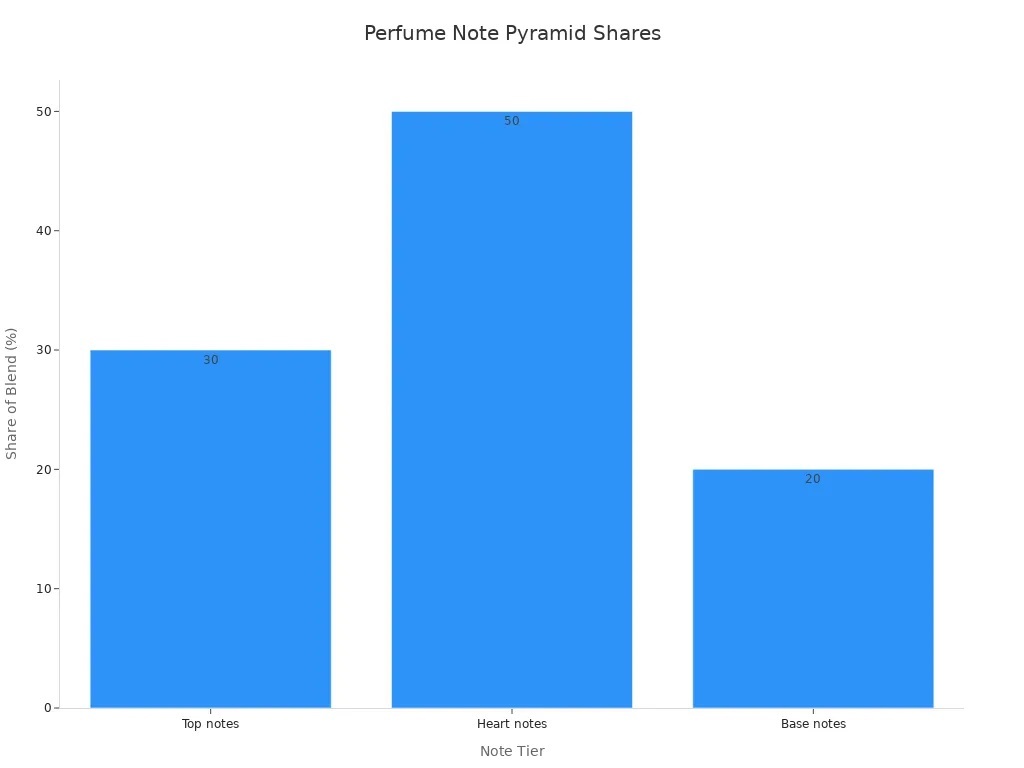
A common starting structure divides the blend like this:
|
Note Tier |
Share of Blend |
Role in Balance |
|---|---|---|
|
Top notes |
~30% |
Striking opening |
|
Heart notes |
~50% |
Core of the fragrance |
|
Base notes |
~20% |
Lasting depth |
How Notes Work Together
Balance means no single note overpowers the others. Each layer supports the next one over time. Watch the sequence unfold:
-
Top notes capture attention at first spray.
-
Heart notes define the scent's character.
-
Base notes create the lasting memory and anchor longevity.
A blend that leans heavily on top notes without a solid base tends to fade faster than you want. The opening sparkles, then disappears, and nothing holds the scent in place. Give the base its share and the heart notes have time to develop.
Test this yourself. Build one trial with the shares above and a second trial with extra top notes. Compare how long each one stays noticeable. You will feel the difference within an afternoon, and that lesson sticks better than any chart.
Tools and Oils
Equipment and Carrier Oils
You need a small set of supplies before you blend. Gather a carrier oil, your scent oils, a few small bottles, fragrance strips or cotton balls, and patience. The blend needs time to settle. Plan for that wait from the start.
The carrier oil shapes how the perfume feels on skin. Each option brings different strengths:
|
Carrier Oil |
Key Properties |
Best For |
|---|---|---|
|
Jojoba Oil |
Odorless liquid wax; resists rancidity; mimics skin's sebum |
Floral and citrus blends; roll-ons |
|
Fractionated Coconut Oil |
Stays liquid at room temperature; light and non-greasy |
Quick-absorbing blends in humid weather |
|
Sweet Almond Oil |
Helps blends settle evenly; gentle on sensitive skin |
Beginners testing new scents |
|
Grapeseed Oil |
Cold-pressed; supports a long shelf life |
Perfumes meant to last |
|
Avocado Oil |
Holds essential oils well |
All-day wear |
Jojoba suits almost any perfume form. Fractionated coconut oil works well in hot climates. Sweet almond oil helps a blend even out. Choose one carrier and learn how it behaves before you try another.
Choosing Fragrance Oils for Perfume
Quality decides whether your blend smells clean and stable. Start with purity. A good oil contains no dyes, residues, or hidden additives. Impure oils may hide undisclosed synthetics or cheap carrier oils, and those shortcuts ruin a scent over time.
Look at the raw materials next. Reputable suppliers research their sources and store oils correctly. Light, heat, and oxygen degrade oils, so cool, airtight storage matters. Price offers another clue. Genuine oils are never cheap, and a bargain price often signals adulteration. Check that each scent meets recognized safety standards before you buy. Finally, verify the supplier. Request samples, run a sniff test, and confirm a solid reputation.
Yahebio supplies quality Fragrance Oils for Perfume with these checks in mind. Their Fragrance Oil for Men line suits bolder, woodier profiles. A good supplier makes the whole process easier.
Blending Techniques and Ratios
Layering Fragrance Oils for Perfume
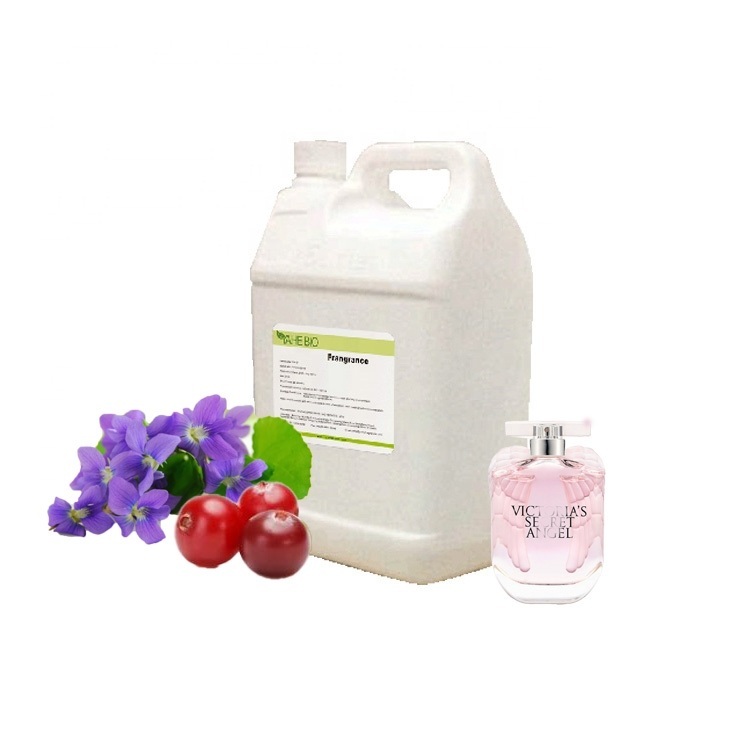
Order matters as much as proportion. Add your heaviest material first, then work toward the lightest. A potent creamy base goes in first. Essential oils follow. Light, alcohol-based notes go last. This sequence gives the base time to settle into the carrier while the volatile top notes stay fresh for the opening.
|
Layering Step |
What You Add |
Why It Comes Here |
|---|---|---|
|
1 |
Base note oil (sandalwood, musk, vanilla) |
Forms a lasting foundation and adds depth |
|
2 |
Heart note oil (floral or fruity) |
Bridges the layers and carries the theme |
|
3 |
Top note oil (citrus or light florals) |
Adds an immediate fresh burst |
Stir gently after each addition. Let the bottle rest between steps. Rushing the order flattens the opening and shortens the trail.
The 50-30-20 Ratio Rule
The 50-30-20 rule translates the note pyramid into a working guideline. Heart notes take about 50 percent of the composition. Top notes take roughly 30 percent. Base notes hold about 20 percent. Treat it as a framework for interpretation, not a strict milligram formula.
|
Note Layer |
Share |
Perceived Duration |
Role |
|---|---|---|---|
|
Top notes |
~30% |
5–30 minutes |
Immediate opening that captures attention |
|
Heart notes |
~50% |
2–4 hours |
Carries the main theme and defines personality |
|
Base notes |
~20% |
6–8 hours or more |
Prolongs presence and leaves the lasting trace |
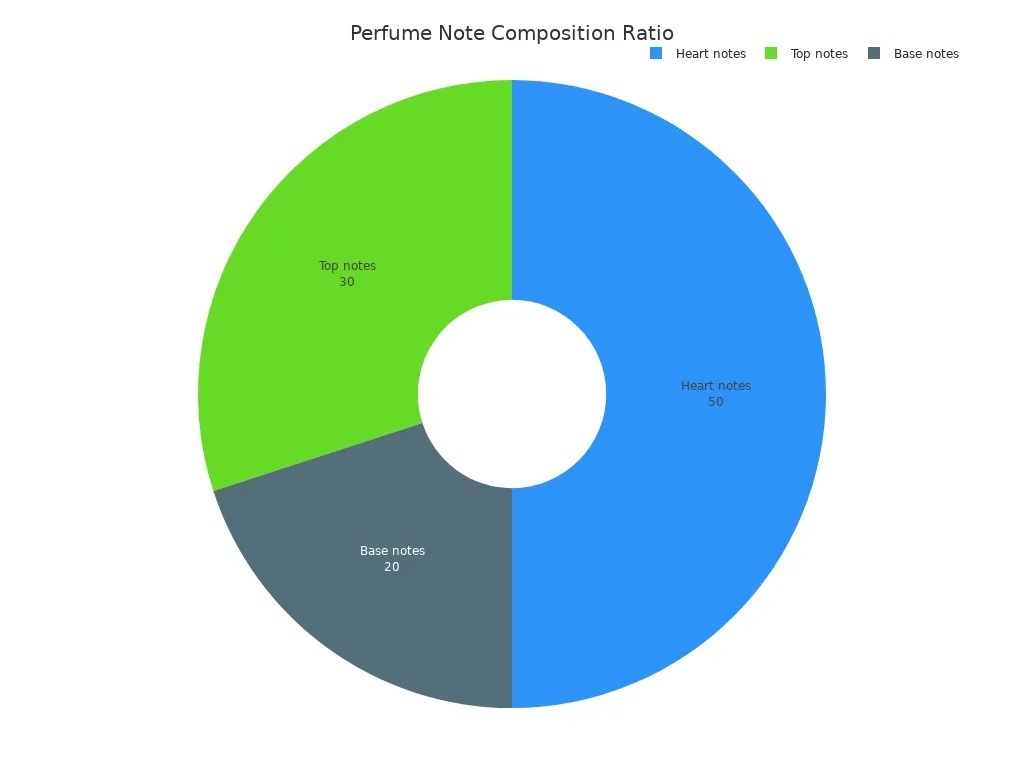
Use the rule to read a blend in three stages. First, judge the opening and ask whether you truly like that first impression. Next, wait for the heart to emerge and ask whether this is the personality you want to wear. Finally, judge the drydown and ask whether this is the trail you want to leave. If two trials tie, pick the one whose base makes you want to smell your wrist hours later.
A Designer Inspired Luxury Perfume Oil can serve as a reference point here. Smell it, note where its weight sits, then build your own direction around that balance. Quality Fragrance Oils for Perfum make this comparison honest, because each layer reads clearly instead of blurring together.
Testing and Adjusting
Strip and Skin Testing
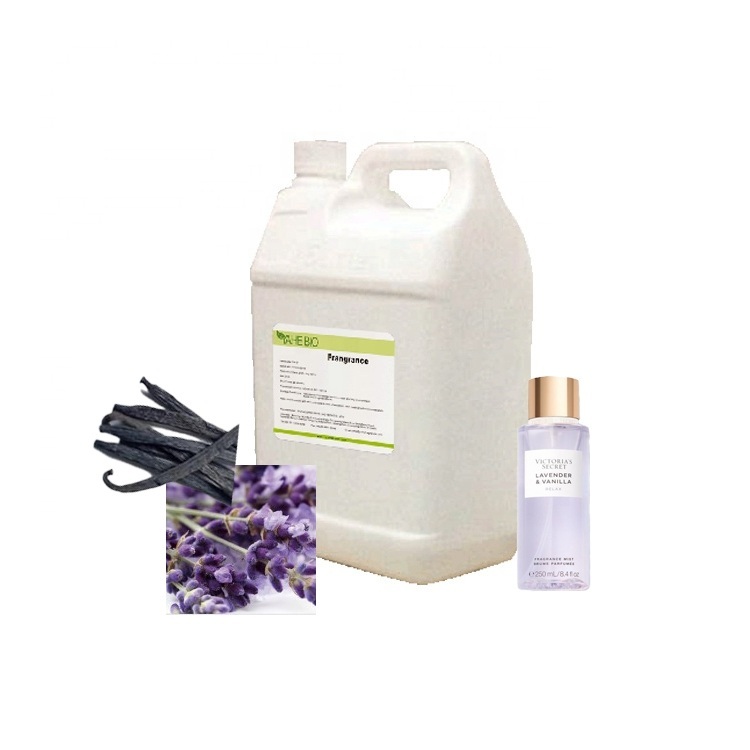
Testing separates a promising blend from a wearable one. Start with strips, then move to skin. Each method answers a different question.
|
Factor |
Blotter (Strip) Testing |
Skin Testing |
|---|---|---|
|
Scent Realism |
Neutral, surface-level impression |
Personal, full scent development |
|
Note Accuracy |
Highlights top notes |
Reveals heart and base notes |
|
Testing Capacity |
Up to 5 fragrances |
Limited to 2–3 spots on the skin |
|
Temperature |
Room temperature |
Warm (~98.6°F), speeds up evaporation |
|
Purpose |
Shortlisting options |
Finalizing decisions |
Add one drop of each oil to a strip or cotton ball in your intended ratios. Hold it at arm's length and inhale. Build an aroma wand with five strips, then fan them to evaluate combinations. Sniff bottle caps side by side to check compatibility.
Blotter dipping gives you control over presence. Dip one blotter to the second line to give that fragrance a stronger voice. Dip both to the first line for a 50/50 blend.
For spray-based trials, hold the bottle about 4–8 inches away and spray once. Take an immediate sniff to catch the top notes. Revisit the blotter after 20–30 minutes to detect the heart notes. Limit testing to 3–5 fragrances at a time to avoid olfactory fatigue. Reset your nose with coffee beans, fine pepper, or the clean skin of your elbow.
Skin testing completes the picture. Spray from about 4–8 inches onto pulse points, where warmth helps the fragrance develop. Do not rub your wrists together, since that breaks down fragrance molecules and causes faster fading. Prepare skin with an unscented lotion beforehand. Allow 20–30 minutes for the scent to settle before judging, and test no more than 2–3 fragrances at once.
"If a comparison were to be made between a blotter and the skin, we would speak of a one-dimensional experience on paper, and a three-dimensional one on the skin." — Sylvaine Delacourte
Start with blotters to shortlist. Test top picks on skin for longevity and evolution. Wear the winner for hours, or sleep with it, to experience the full dry-down.
Fixing an Unbalanced Blend
An unbalanced blend usually needs a small correction, not a rebuild. Diagnose first, then adjust one variable at a time.
|
Adjustment Technique |
Guidance for Achieving Balance |
|---|---|
|
Ratio adjustment |
Add more of the lighter scent to brighten a faint blend, or reinforce the base with extra sprays of the heavier note. |
|
80/20 weighting rule |
Use roughly 80% neutral base notes and 20% of a bold accent fragrance for a harmonious trail. |
|
Starting ratio |
Begin with a 2:1:1 ratio of base, heart, and top notes, and track adjustments against your skin chemistry. |
|
Fixative proportion |
Build around the fixative rather than adding it later; fixatives are typically 3–5% of base notes, and potent ones such as ambrette seed should stay at 0.5% or less. |
|
Volatility matching |
Pair citrus oils with low-vapour-pressure fixatives such as benzoin or labdanum so the fixative traps lighter molecules. |
|
Maceration |
Let the blend rest 24–48 hours, or several days for a refined result, so notes meld and longevity improves. |
Quality Fragrance Oils for Perfum make these corrections predictable, because each note reads clearly instead of blurring. Keep notes on every tweak. A simple log of drops and dates turns guesswork into a repeatable process.
Safety and Smart Habits
Dilution and Storage
A strong scent does not need a strong concentration. Dilute every blend before it touches your skin, and match the percentage to where you plan to wear it.
|
Application Area |
Safe Dilution Range |
|---|---|
|
Sensitive or reaction-prone skin |
0.2–1% |
|
Facial cosmetics and deodorants |
0.5–1.2% |
|
Body oils and lotions |
1–3% |
|
Bath and wash-off products |
2–4% |
|
Pain and feel-good rollerballs |
3–10% |
Start at the low end of the range for your chosen use. Patch test a small area first, then wait a full day before you apply the blend more widely. A Branded Roll on Essential Perfume Oil from Yahebio gives you controlled application, because the roller delivers a measured amount instead of a free pour.
Storage protects everything you just built. Keep bottles away from heat and direct light. Cap them tightly after each use, since oxygen slowly degrades aromatic compounds. A cool, dark drawer works better than a sunny shelf. Label the fill date on every bottle and revisit older blends before you wear them.
Labeling Basics
A simple label saves you from confusion later. Write four things on each bottle: the scent name, the dilution percentage, the carrier oil, and the date you mixed it. Add the note ratio if you plan to repeat the blend.
Keep your labels short and readable. A strip of masking tape and a fine marker handle the job. Store a matching entry in a notebook with the exact drop counts. That record turns a lucky accident into a recipe you can rebuild.
Buy your supplies from a source you trust. Quality Fragrance Oils for Perfum behave predictably at these dilution levels, and predictable behavior is what keeps a home blend safe and repeatable.
Start small. Blend a simple three-note trial, test it on a strip and on your skin, then adjust before you scale up. Balance comes from note structure, measured ratios, patient testing, and safe dilution. Nothing else replaces those four habits.
Quality supplies make the journey easier and more enjoyable. Yahebio offers Fragrance Oils for Perfum, a Fragrance Oil for Men line for bolder profiles, a Designer Inspired Luxury Perfume Oil as a reference point, and a Branded Roll on Essential Perfume Oil for controlled application. Grab your strips, mix a tiny batch, and experiment with confidence. Your first wearable scent is closer than you think.
FAQ
How many fragrance oils should a beginner start with?
Start with three. Choose one top, one heart, and one base note. A three-note trial teaches you how the layers interact, and it keeps your first batch simple. Add more oils only after you understand how each one behaves in your carrier.
How long should a new blend rest before you judge it?
Give it 24 to 48 hours at minimum. Several days gives a more refined result. This resting period, called maceration, lets the notes meld and improves longevity. Sniff the blend again after a week and compare it to your first impression.
Why does the same blend smell different on two people?
Skin chemistry, body temperature, and dryness all shift how a fragrance develops. That is why strip testing shortlists a blend and skin testing finalizes it. Test on your own pulse points, and judge the drydown on your skin rather than on paper.
How do you know when a blend is balanced?
The opening should please you, the heart should feel like the personality you want to wear, and the base should still smell good hours later. If one layer dominates, adjust a single variable and retest. Quality Fragrance Oils for Perfume make each layer easier to read.
Can you fix a blend that smells too sharp or too flat?
Yes. Add a drop of a softer heart note to round off a sharp edge. Brighten a flat blend with a light top note. Reinforce a weak trail with extra base. Change one thing at a time, then retest on a fresh strip.