HVA-2 Application in Rubber Tire: The Ultimate Solution for Reversion and Shoulder Separation
-By Yangchen Advanced Materials – A Leading HVA-2 Manufacturer
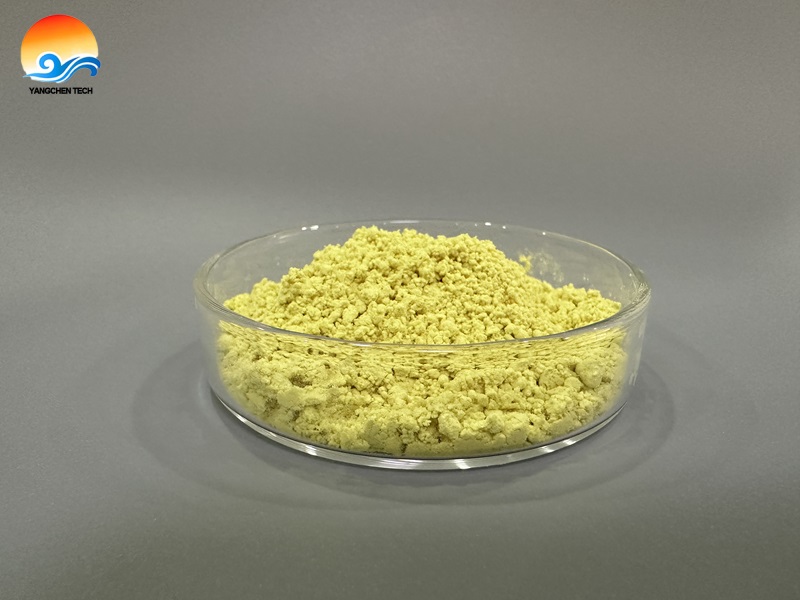
If you are a tire compounder or a rubber technologist, you have probably faced two persistent nightmares: reversion and shoulder separation. These issues not only reduce tire life but also increase warranty claims and damage brand reputation.
HVA-2 (N,N’-m-Phenylene bismaleimide) – also known as PDM or HA-8 – is a multifunctional rubber additive that effectively eliminates these problems. In this article, we will explore the HVA-2 application in rubber tire manufacturing, backed by real performance data, and explain why Yangchentech is your most reliable supply partner.
1.What is HVA-2?
HVA-2 is an aromatic bismaleimide with two reactive double bonds. It acts as:
- Anti-reversion agent in sulfur-cured natural rubber
- Co-agent in peroxide systems
- Adhesion promoter between rubber and cords
- Heat-resistant modifier for thick rubber articles
Its chemical structure allows it to form thermally stable carbon-carbon crosslinks, which do not break down under prolonged high-temperature vulcanization.
2.Why Does the Tire Industry Need HVA-2?
Modern tire manufacturing demands higher productivity (shorter cure times) and larger, heavier loads (more heat generation). Conventional sulfur vulcanization produces polysulfidic bonds that are stable only within a narrow temperature window. Once the temperature exceeds 150°C for extended periods (typical in thick tire components), reversion occurs: crosslinks break, network density drops, and mechanical properties collapse.
- Consequences of reversion in tires:
- Reduced tread stiffness and tear strength
- Shoulder separation – a common failure mode in bias truck tires
- Poor belt edge adhesion
- Lower retention of dynamic properties
HVA-2 solves this by generating hybrid crosslinks that resist thermal cleavage, maintaining torque even after 30 minutes at 170°C.
3.Key Benefits of HVA-2 Application in Rubber Tire
Eliminates Reversion – Proven by Data
| Testing Condition | Conventional Sulfur Cure | Sulfur + 2.5 phr HVA-2 |
| Torque retention after 170°C×30 min | 85–88% | 98–100% |
| Tensile strength retention (100°C×72h) | 72–78% | 90–95% |
| Modulus at 300% (MPa) | Baseline | +15% |
With HVA-2, your tire compound stays robust even under severe overcure conditions.
Prevents Shoulder Separation in Bias Truck Tires
Adding 2–3 phr of HVA-2 to the shoulder pad and breaker compounds significantly improves the adhesion between natural rubber and nylon/polyester cords. The maleimide ring reacts with amino groups on the fiber surface, forming a covalent bond that withstands dynamic flexing and heat aging.
Result: Reduced scrap rates and fewer field failures.
Improves Heat Aging Resistance
HVA-2’s hybrid crosslinks do not revert, so the rubber retains its mechanical integrity after prolonged heat exposure. This translates into longer tire life for long-haul trucks and OTR vehicles.
Enhances Processing Safety
At low dosages (0.5–1.0 phr), HVA-2 acts as a scorch retarder, delaying Mooney scorch time by 15–20% without affecting cure rate. This gives you a wider processing window, especially during hot summer shop-floor conditions.